
 Canada
 Français
 Español
 International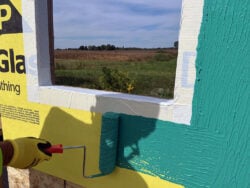
AIR-SHIELD™ STPE is a fluid-applied, vapor-permeable air and moisture barrier designed to help control air leakage and water intrusion in wall assemblies. This single-component, moisture-cured membrane goes on easily by spray, roller, or brush and dries to form a seamless, flexible layer that stays durable over time without becoming brittle.
Formulated with silyl-terminated polyether (STPE) technology, it adheres well to a wide range of substrates—including concrete, CMU, sheathing, metal, and plywood—and can be used in both new construction and retrofit projects. AIR-SHIELD STPE allows moisture vapor to pass through while resisting liquid water, helping walls dry naturally. The product is non-asphaltic, low-VOC, and can be exposed to UV for up to 12 months, making it a reliable, job-site-friendly option for above-grade air barrier applications.
Product Data Sheet

| 07 27 26 |
|

AIR-SHIELD™ STPE
Fluid-Applied, Moisture-Cured, Vapor Permeable Air Barrier
DESCRIPTION
AIR-SHIELD STPE is a single-component, moisture-cured, fluid-applied air and liquid moisture barrier that forms a tough, seamless, elastomeric membrane upon curing. The product is composed of Silyl-Terminated Polyether, providing strength and durability. AIR-SHIELD STPE provides excellent resistance to air leakage and can be applied in a single coat by spray, roller, or brush. When properly integrated into a well-designed wall assembly, AIR-SHIELD STPE serves as a monolithic barrier against air leakage and liquid water intrusion. It offers permanent flexibility, containing no plasticizers or oils that can leach out over time and cause brittleness or cracking.
USES
AIR-SHIELD STPE is specifically formulated to function as a breathable air and liquid moisture barrier, allowing vapor transmission. It can be applied to most common construction materials and is ideal for above-grade wall assemblies in both new construction and retrofit applications. Primary uses include cavity wall and masonry wall systems. Compatible substrates include precast and cast-in-place concrete, concrete masonry units (CMU), fiberglass mat-faced gypsum sheathing, rigid foam insulation, steel, copper, aluminum, exterior-grade plywood (untreated), and oriented strand board (OSB).
FEATURES/BENEFITS
- Quick resistance to rainfall – rain-resistant in <30 minutes at 75° F (24° C) & 50% RH
- Highly sprayable/compatible with a standard Graco GH 833 Sprayer
- May also be applied by roller and brush
- UV exposure up to 12 months
- Resists the growth of mold and fungus.
- Non-asphaltic – designed to meet stringent fire code requirements
- High permeability – allows the transmission of moisture vapor through porous building materials
- Low temperature flexibility – no cracking down to -20° F (-28.9° C)
- Phthalate and Isocyanate free – less toxic
- Highly flexible – bridges cracks, which may form in the substrate.
- Fluid applied – simplifies detailing and assures a monolithic, seamless membrane when applied to a rough or smooth surface.
- Excellent adhesion – remains firmly bonded to the substrate, even when applied over damp surfaces.
- Self-sealing – Nails and fasteners can be used without compromising performance.
PACKAGING
5 Gallon (18.93 Liter) Pails
COVERAGE
| Surface Type | Coverall / Thickness |
| Gypsum, OSB, Plywood | 80 ft.2/gal. (1.7 m2/L) |
| Wet and Dry Film (Cured) Thickness | 20 mil (0.51 mm) |
| CMU, Masonry | 60 ft.2/gal. (1.5 m2/L) |
| Wet and Dry Film (Cured) Thickness | 27 mil (0.68 mm) |
SHELF LIFE
When stored indoors in original, unopened containers at temperatures between 40° – 80° F (4° – 27° C), optimum performance and best use is obtained within one year of date of manufacture.
SPECIFICATIONS/STANDARDS
- Exceeds Air Barrier Association of America (ABAA) requirements for fluid-applied air barriers.
- Exceeds ABAA maximum assembly air leakage requirements when tested in accordance with ASTM E 2357.
- Exceeds ABAA maximum material air leakage requirements when tested in accordance with ASTM E 2178.
- Exceeds the requirements of the Massachusetts Commercial Energy Code for Building Envelope Systems.
- ASTM E84, Class A
- Complies with all current VOC regulations, including National EPA VOC Emission Standard for Architectural Coatings, CARB, LADCO, OTC Phase I and II, Arizona Maricopa County, Utah Department of Environmental Quality, and Colorado VOC regulations.
TECHNICAL DATA
| Color: | Green |
| Solids (ASTM D2369) | 99% |
| Water Vapor Permeance (ASTM E96, Procedure B) |
15 Perms |
| Service Temperature: | Not to exceed 175° F (80° C) |
| Elongation (ASTM D412) | 638% |
| Tensile Strength (ASTM D412) | 100 psi (0.69 MPa) |
| Nail Sealability (ASTM D1970) | Pass |
| Water Penetration (ASTM E331) | Pass |
| Water Resistance (ASTM D2247) |
Pass – No blistering or other deleterious effects |
| Peel Adhesion to Concrete (ASTM C794) | ≥5.0 pli |
| Pull Adhesion (ASTM D4541 M per ABAA) |
≥16 psi (0.1 MPa) |
| Low Temp Flexibility (ASTM D522) |
Pass – No surface change |
| Storage Temperature | 40 – 80° F (4 – 26° C) |
| Air/Substrate Temperature (At Time of Application): |
>25° F (-4° C) and rising |
| VOC Content: | 26.7 g/L |
| Crack Bridging (ASTM C1305) | Pass |
AIR LEAKAGE
| Test Method | ASTM E2178 | ASTM E2357 |
| Pressure | 75 Pa (1.57 lb./ft.2) |
75 Pa (1.57 lb./ft.2) |
| ABAA Requirements | 0.004 cfm/ft.2 (0.02 L/S/M2) | 0.04 cfm/ft.2 (0.2 L/S/M2) |
| AIR-SHIELD STPE Results | 0.0006 cfm/ft.2 (0.0013 L/S/M2) | <0.001 cfm/ft.2 (0.003 L/S/M2) |
All technical data provided is typical and subject to variation due to testing methods, site conditions, temperature, curing conditions, and operator technique. Statistical differences in test results should be expected. On-site testing results may not directly correlate with published data due to these variables.
APPLICATION
Surface Preparation … All surfaces must be dry (no visible surface water), clean, and free of dust, frost, ice, grease, oils, dirt, curing compounds, release agents, coatings, sealers, or any other surface or embedded sealers or contaminants that may adversely affect adhesion. Substrates must be structurally sound and relatively smooth.
For concrete, minimum concrete cure time is three days at 75° F (24° C). Blistering may occur if applied in direct sunlight, especially during the heating part of the day if the internal moisture content of the concrete is not less than 5%, or the relative humidity is not below 75%. Concrete may be highly absorbent and could require additional material to achieve the specified dry film thickness.
Metal surfaces, especially those that are rusted, oxidized, or contaminated, may require sanding or mechanical abrasion. Exposed steel should be abrasive blasted and vacuumed clean. If abrasive blasting is not feasible, degrease the surface and abrade with sandpaper or a wire brush until rust, oxidation, or contamination is removed.
All wall assemblies receiving AIR-SHIELD STPE must be properly capped to prevent moisture infiltration during construction.
Exterior Sheathing Panels … Exterior sheathing panels are to be installed and fastened per manufacturer’s recommendation.
Rough Openings … AIR-SHIELD LIQUID FLASHING from W. R. MEADOWS is compatible with AIR-SHIELD STPE for rough openings, window flashing, and other related applications.
Sequence of flashing membrane should occur prior to AIR-SHIELD STPE applications. In select locations where this sequence cannot occur, AIR-SHIELD BUTYL FLASHING may be used as a flashing membrane after fully cured and solvent-wiped locations of AIR-SHIELD STPE have been identified.
Concrete Masonry Units … Before applying AIR-SHIELD STPE to CMU surfaces, patch all cracks, protrusions, small voids, offsets, details, irregularities, and small deformities with MEADOW-PATCH® 5 or MEADOW-PATCH 20 from W. R. MEADOWS at least two hours before application.
Temperature/Conditions … Drying (curing) times are dependent on air temperature, airflow, relative humidity, substrate temperature, wind chill, dew point, etc. For example, as the temperature decreases, the dry time will increase and the time to achieve rain resistance will be extended. If the temperature drops below 40° F (5° C), dry time (cure rate) and resistance to precipitation and dew will be delayed. Protect membrane from precipitation and washout prior to drying. Exposure to air temperatures <25° F (-4° C) during drying may lead to decrease of performance.
Typical Dry Times:
Tack-Free Time: 3 hours at 75° F (24° C) & 50% RH
Dry Time: 48 hours at 75° F (24° C) & 50% RH
Roller … AIR-SHIELD STPE can be applied directly from the container; a ¾” (19.1 mm) nap roller is recommended. Apply AIR-SHIELD STPE on a vertical surface, in multiple coats if necessary, to achieve a final film thickness based on substrate type stated under COVERAGE. NOTE: While the proper film thickness may be achieved with a single coat, multiple coats may be necessary if the material slumps due to temperature and/or substrate conditions. Allow each previous coat to dry (approximately one hour) prior to applying the next coat.
Sprayer … AIR-SHIELD STPE should be stored and maintained at a temperature of 60˚ F (16° C) or higher throughout the entire spray application. Note: Use of Graco GH833 is recommended for optimum performance. A Graco heavy duty texture gun with either a 0.051” (Graco GHD 551), 0.035” (Graco GHD 535), or 0.037” (Graco GHD 537) spray tip is recommended. If cratering occurs, the GHD 535 or 537 is recommended for a smoother finish.
Spray AIR-SHIELD STPE on a vertical surface, in multiple coats if necessary, to achieve a final film thickness stated under COVERAGE. NOTE: While the proper film thickness may be achieved with a single coat, multiple coats may be necessary if the material slumps due to temperature and/or substrate condition. If the profile is highly rough and porous, two coats applied perpendicular to each coat will be required to ensure a uniform and continuous film has been achieved. Allow each previous coat to dry two hours prior to applying the next coat.
Film Thickness … Frequently inspect the surface with a wet film gauge to verify that proper film thickness is achieved and that the film thickness is uniform over the entire surface. Porous substrates, masonry blocks, etc., may require multiple coats to achieve recommended film thickness.
Cleanup … Material should not be left in the pump, lines, or gun when finished spraying. After spraying, flush aromatic solvents, such as mineral spirits, xylene, or toluene, through the system until pump and hose are clear (approximately two gallons). Do not flush with water.
LIMITATIONS/PRECAUTIONS
DO NOT FREEZE. Keep containers tightly sealed. Maximum UV exposure period is twelve months; after 12 months, reapplication will be required. Tack, PSA, and spray adhesives (such as tapes and sheet membranes) will not bond well since this material is silyl-terminated polyether based. For optimal performance, apply AIR-SHIELD STPE over existing waterproofing membranes or over STPE-based sealants or detailing mastics such as AIR-SHIELD LIQUID FLASHING or BEM. AIR-SHIELD self-adhered rubberized asphalt flashings as well as POINTING MASTIC from W. R. MEADOWS should not be applied over AIR-SHIELD STPE. Silane and hybrid sealants in general will adhere well to cured AIR-SHIELD STPE. Always confirm compatibility and adhesion with manufacturer of sealant prior to install. It is recommended that the roof is installed prior to the application of the AIR-SHIELD STPE. This will help avoid water from getting behind the backup wall or filling the CMU block, which can potentially lead to jobsite concerns. Do not apply AIR-SHIELD STPE if precipitation is forecast or imminent within 2 hours at 75° F (24° C) and 50% RH of application. Adhesion of membrane on oriented strand board (OSB) and treated lumber can sometimes be affected by the level of surface texture, presence of wax or level and type of treatments. Prior to placement on OSB or treated lumber, in-situ adhesion tests should be performed to determine suitability of substrate prior to full installation. If there are variations in the OSB surface, multiple tests may be required.
HEALTH AND SAFETY
Direct contact may result in mild irritation to the skin and eyes. Should adverse effects occur, remove subject from area immediately. If irritation occurs and persists, move victim from exposure source and treat symptomatically. Flush affected areas with mild soap and water. Refer to safety data sheet for complete health and safety information.
2026-04


