Canada
 Français
 Español
 International
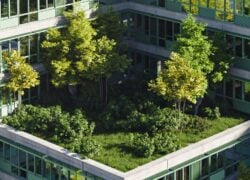
 Green roofs are often introduced into a project as a sustainability feature, an amenity, or a response to regulatory requirements. But long-term success depends on something far more fundamental: understanding that a green roof is a fully coordinated building system, not simply a collection of interchangeable materials placed on top of a roof.
When green roofs underperform, or fail entirely, it is rarely because a single product was “bad.” More often, problems arise when individual components are selected in isolation, without considering how they interact as part of a layered assembly. Each layer in a green roof has a specific purpose, and more importantly, each layer exists to protect the one below it. When this hierarchy is respected, green roofs perform predictably and deliver long-term value. When it is ignored, risk increases dramatically.
A GREEN ROOF IS A ROOFING SYSTEM FIRST
At its core, a green roof is still a roofing system. It must manage water, protect the building enclosure, and perform reliably for decades, often with limited access for repair. The vegetated layer may be the most visible component, but it is also the most dependent on the layers beneath it.
Designing a green roof as a system means recognizing that performance is cumulative. A failure in one layer often compromises multiple layers above and below it. This is why green roofs should never be treated as decorative add-ons or late-stage upgrades. They demand early coordination, clear detailing, and disciplined system thinking.
THE LAYERED ASSEMBLY: HOW EACH COMPONENT WORKS TOGETHER
Vegetation: The Visible Outcome, Not the Driver
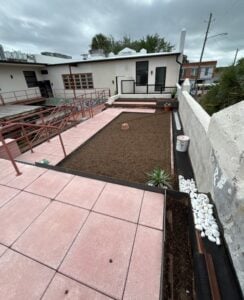
The vegetation is what most people associate with green roofs, but plants are only as successful as the system supporting them. Plant selection must align with soil depth, drainage capacity, irrigation strategy, and maintenance expectations. When plants struggle, it is often a symptom of deeper system issues, not simply poor plant choice.
Growing Media: Engineered, Not Natural
Green roof growing media is not conventional topsoil. It is a highly engineered blend of mineral aggregates and organic materials designed to balance weight, drainage, moisture retention, and nutrients. On a roof, saturated weight matters. Media that is too heavy can overload the structure, while media that drains poorly can clog drainage layers and stress the waterproofing.
Proper growing media resists compaction, drains efficiently, and provides a stable root environment over time. Its performance directly affects stormwater retention, plant health, and long-term system reliability.
Filter Fabric and Protection Layers: Small Details, Big Consequences
One of the most overlooked components in green roof assemblies is the filter fabric or protection layer placed beneath the growing media. Its role is deceptively simple: prevent fine particles from migrating downward.
Without this layer, fines wash into the drainage layer, reducing flow capacity and leading to ponding water. Over time, this creates hydrostatic pressure against the waterproofing membrane, one of the most common precursors to membrane failure. Though rarely visible after installation, this layer plays a critical role in preserving drainage performance and protecting the system below.
Drainage Layer: Managing Water, Not Eliminating It
Drainage in green roofs is about control, not speed. The drainage layer must move excess water efficiently toward roof drains while retaining enough moisture to support plant health. Different green roof types require different drainage profiles, with deeper systems often needing greater water retention capacity.
From a design standpoint, drainage performance affects both vegetation success and waterproofing longevity. Poor drainage stresses the entire assembly, while well-coordinated drainage allows the system to function as intended through seasonal cycles and major storm events.
Insulation: Thermal Stability and Protection
In many protected membrane assemblies, insulation (commonly extruded polystyrene, or XPS) is placed above the waterproofing membrane. XPS resists moisture absorption and helps shield the membrane from temperature extremes and mechanical damage.
This configuration stabilizes thermal performance and reduces stress caused by expansion and contraction. Over time, this thermal buffering contributes to longer membrane service life and more consistent enclosure performance.
Root Barrier: Long-Term Insurance
Root barriers are sometimes underestimated, especially when “non-aggressive” plant palettes are specified. However, green roofs are living systems that evolve over time. Root barriers provide long-term protection by preventing root intrusion into the waterproofing membrane.
Even when membranes are marketed as root-resistant, dedicated root barriers add redundancy, an essential principle in assemblies where access for repair is limited and costly.
Waterproofing Membrane: The Most Critical Layer
At the heart of every green roof is the waterproofing membrane. Once the green roof is installed, this layer becomes the least accessible and most expensive to repair. For that reason, it must be continuous, durable, and fully compatible with vegetated assemblies.
Protected membrane systems dramatically extend membrane service life by shielding it from UV exposure, thermal shock, and physical abuse. In many green roof assemblies, the membrane becomes one of the most protected components of the entire building enclosure, provided it is designed and installed correctly from the start.
Structural Deck: The Foundation of the System
All green roof layers ultimately rely on a structurally sound roof deck, typically concrete in vegetated applications. The deck must accommodate dead loads, saturated conditions, and live loads where applicable. Structural coordination is not optional – it is foundational.
WHY SYSTEM THINKING REDUCES RISK
When green roofs are treated as layered systems rather than product stacks, several benefits follow:
- Improved durability through protected waterproofing
- Predictable stormwater performance
- Reduced maintenance-related damage
- Lower long-term liability for design teams and owners
- Extended service life of the roof assembly
Failures most often occur when access is not planned, drainage is compromised, or waterproofing details are buried and forgotten. These are system failures, not product failures.
DESIGNING FOR THE FULL LIFECYCLE
A successful green roof does not end at installation. Inspection access, maintenance pathways, and long-term care must be considered part of the original design intent. When assemblies are layered correctly and access is preserved, green roofs often outperform conventional roofs over time – both technically and financially.
The most reliable green roofs are those designed with humility and discipline: acknowledging that every layer matters, every detail counts, and every decision affects what lies beneath.
Request More Information
To contact your local W. R. MEADOWS representative or for general correspondence, please click here. If you need immediate assistance, please call (800) 342-5976. Thank you!