
 Canada
 Français
 Español
 International
Concrete finishing is becoming more challenging, and for many contractors, the change has been noticeable. Slabs that once stayed workable now tighten up faster. Surfaces that used to respond predictably during troweling can become crusted or difficult to close. The finishing window feels shorter, and the margin for error is smaller. These are not isolated jobsite issues. They are the direct result of how concrete itself has evolved.
To understand finishing aids, it is important to first understand what has changed in modern concrete and why those changes have made surface work more difficult.
What Changed: Modern Mix Designs, Blended Cement
In recent years, the industry has shifted significantly from traditional Type I cement to Type 1L cement, largely driven by sustainability goals. Today’s concrete mixes are engineered for performance, durability, and reduced environmental impact. Producers are using lower water to cement mix designs, incorporating supplementary cementitious materials, and optimizing aggregate gradations to create stronger and more durable concrete.
One of the most important developments has been the growing use of blended cements (including Type 1L), which reduces the carbon footprint of concrete by lowering clinker content and incorporating finely inter-ground limestone.
While these advancements improve long-term performance, they also change how concrete behaves during placement and finishing. One of the most important changes is that modern concrete produces significantly less bleed water. Bleed water is the water that rises to the surface of freshly placed concrete as heavier solids settle. Historically, this water played a critical role during finishing by helping keep the surface workable, providing natural lubrication for finishing tools, and extending the time crews had to achieve the desired finish.
When evaporation outpaces moisture movement within the slab, the surface begins to stiffen prematurely. On the jobsite, this shows up as crusting, increased trowel drag, and difficulty achieving a smooth, uniform finish. In more severe cases, it can lead to plastic shrinkage cracking before finishing is even complete.
What Are Finishing Aids?
Finishing aids, sometimes referred to as troweling aids, are materials designed to improve the workability and finishability of concrete surfaces during the finishing process. They are most commonly applied as a spray directly to the surface during floating or troweling operations.
At their core, finishing aids are designed to make the surface easier to work and finish. They reduce friction between finishing tools and the concrete, improve surface cohesion, and help extend the workable finishing window. What makes them especially important in modern construction is that they achieve this without increasing the water-to-cement ratio.
Adding water to the surface, often referred to as “blessing the concrete”, has been done in the field but is not an accepted practice. It weakens the concrete surface and can lead to long-term durability issues such as dusting, scaling, and reduced wear resistance.
The Science Behind Finishing Aids
Finishing aids are a newer category of concrete construction products based on colloidal silica technology. Colloidal silica is a dispersion of extremely small amorphous silicon dioxide (silica) particles suspended in water, typically in the nanometer size range. Because of their ultra-small particles and high surface area, these silica particles are highly reactive within cementitious systems.
In concrete, colloidal silica chemically reacts with calcium hydroxide, a byproduct generated during cement hydration, to form additional calcium silicate hydrate (C-S-H), the primary compound responsible for concrete strength and durability. At the same time, the nano-silica particles can interact with one another through reactive silanol groups present on their surface. Depending on factors such as pH, ionic concentration, and the chemistry of the cement pore solution, these particles may begin forming a connected silica network or gel structure within the surface paste.
At the same time, the water-based carrier and fine particle distribution enhance surface lubricity, allowing finishing tools to move more smoothly across the slab.
On the jobsite, this translates into a surface that feels more workable and responsive. Instead of dragging or tearing under a trowel, the concrete behaves in a more controlled and consistent manner.
Finishing Aids vs. Evaporation Retardants
Finishing aids and evaporation retarders are often confused, but they serve different primary functions.
Evaporation retardants are designed to control the rate of moisture loss from the surface of fresh concrete. They form a temporary monomolecular film that reduces evaporation and helps prevent plastic shrinkage cracking. Industry guidance, including ACI 308, recognizes evaporation retarders as a valid initial or intermediate curing method, particularly before or between finishing operations to prevent premature surface drying. However, they should never be worked into the surface of the concrete.
Finishing aids, on the other hand, are designed to improve how the concrete surface behaves during finishing operations. They help improve surface workability, lubricity, and finishing consistency during floating and troweling. Some finishing aids may also provide evaporation control and can function as both finishing aid and an evaporation retardants. However, evaporation retardants are intended only for moisture control and are not designed to improve finishing characteristics.
In simple terms, evaporation retardants focus on surface moisture control, while finishing aids primarily focus on workability, although some finishing aids may provide both benefits.
Surface-Applied vs. Admixture-Based (Integral) Finishing Aids
Most finishing aids used today are surface-applied products. They are spray-applied directly to the surface during finishing operations, giving contractors real-time control over workability where it matters most. This allows crews to respond to changing jobsite conditions such as weather, timing, and surface behavior.
There is also admixture-based (integral) finishing aids on the market. These are added directly into the concrete mix at the batch plant and are designed to provide built-in improvements to surface workability throughout the concrete placement.
Finishing aids are still an evolving, non-standardized category of concrete construction products. Finishability is influenced by many variables, including mix design, environmental conditions, placement methods, and finishing techniques. As a result, product performance is often evaluated through field experience and practical jobsite performance rather than through a single standardized laboratory test method.
Why This Category Is Growing
The rise of finishing aids reflects a broader shift in the construction industry. While performance, appearance, and constructability have always been important, modern mix designs have made it more difficult to achieve the same level of finish using traditional methods alone.
Today’s concrete mixes, especially those using Type 1L cement, are more difficult to work with at the surface due to reduced bleed water and faster drying characteristics. Contractors are being asked to deliver the same, or better, appearance and surface quality, but with a tighter finishing window and less natural workability.
This gap between material performance and surface finish expectations is exactly why this category is growing.
Finishing aids provide a solution by restoring control at the surface. They allow contractors to achieve high-quality finishes without compromising the integrity of the concrete. Rather than relying on outdated practices, they offer a more engineered and predictable approach to finishing.
The Role of Finishing Aids Moving Forward
Finishing aids are not just another product category. They are a direct response to fundamental changes in how concrete is designed and placed.
As modern mix designs become more prevalent, the need for surface-focused solutions will only continue to grow. Finishing aids help bridge the gap between advanced material science and real-world jobsite performance.
By improving finishability at the surface, they give contractors the ability to adapt to modern concrete while maintaining quality, consistency, and long-term durability.
WHAT IS CLINKER CONTENT - AND WHY DOES IT MATTER?
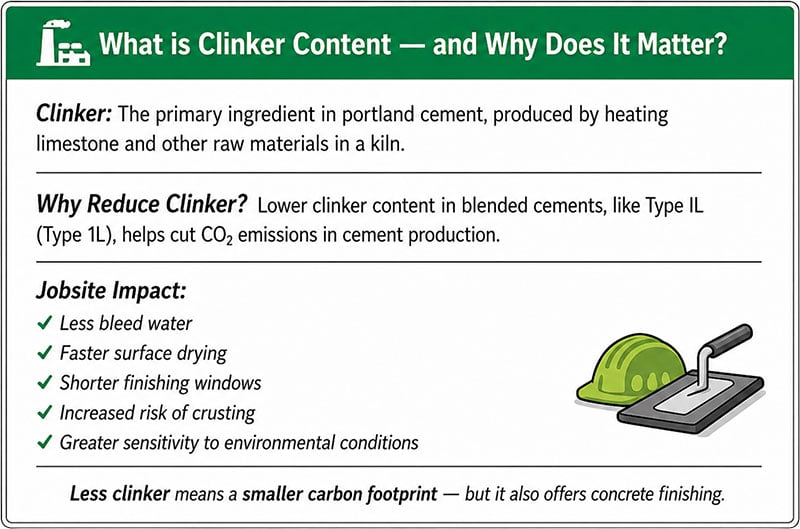
Clinker is the primary ingredient in portland cement. It is produced by heating limestone and other raw materials in a kiln at extremely high temperatures until they form hard, marble-like nodules called clinker. These nodules are then ground into the cement used to make concrete.
Traditionally, cement contained a higher percentage of clinker. Today, many modern blended cements, including Type IL (Type 1L), reduce clinker content by replacing a portion with finely ground limestone and other supplementary materials.
Why make the change?
Lower clinker content helps reduce the environmental impact of cement production because clinker manufacturing is one of the largest sources of CO₂ emissions in concrete production.
What does that mean on the jobsite?
Lower-clinker and blended cement systems can behave differently during placement and finishing. Contractors may notice:
These changes are one reason finishing practices and surface-focused solutions, like evaporation control and finishing aids, are receiving more attention in modern concrete construction.
In short: Less clinker helps reduce carbon footprint — but it can also change how concrete behaves during finishing.


