
 Canada
 Français
 Español
 International
Concrete floor slabs serve as critical working surfaces in warehouses, manufacturing plants, distribution centers, retail environments, and institutional facilities. These floors support constant traffic from forklifts, pallet jacks, carts, and other material-handling equipment. Because of this heavy use, maintaining the durability of the concrete slab, particularly at control joints, is essential for long-term floor performance.
Control joints are intentionally placed in concrete slabs to manage shrinkage and direct cracking to predetermined locations. While these joints are necessary for proper slab performance, they also create potential points of weakness if left unprotected. Once a building becomes operational, repeated traffic across open joints can lead to edge damage, spalling, and progressive deterioration.
Control joint fillers are used to stabilize and protect these vulnerable areas. Among the materials used for this purpose, polyurea technology has become widely adopted because of its rapid curing properties and ability to support efficient installation schedules.
Polyurea is a very rapid-curing, two-component thermoset material that reacts chemically to form a durable polymer capable of supporting joint edges while accommodating minor slab movement. Understanding how polyurea joint fillers function, and how they compare to other materials used for joint filling, helps contractors and specifiers select the appropriate solution for protecting concrete floors.
How Control Joint Fillers Protect Concrete Slabs
To understand the role of joint fillers, it helps to consider how concrete slabs behave under traffic loads. A control joint essentially separates two independent sections of a concrete slab. These joints are intentionally created during construction to control where shrinkage cracking occurs. In simple terms, control joints are planned cracks that allow the slab to relieve internal stress in a predictable location rather than forming random cracks across the floor.
However, once a facility becomes operational, these joints are repeatedly crossed by wheeled traffic. When a heavy load approaches the edge of a slab, the slab will deflect slightly under that load. Even small movement can create a temporary height difference between adjacent slab panels.
Consider a fully loaded forklift or heavy industrial vehicle crossing a control joint. As the wheel approaches the edge of one slab section, that slab may flex downward slightly due to the load. This creates a minor height differential between the two slab edges. When the wheel reaches the opposite side of the joint, it can strike the adjacent edge with concentrated force.
Over time, repeated impacts can cause slab edges to chip, crack, or spall. Joint fillers help prevent this damage by occupying the joint space and providing structural support between the slab edges. When properly installed, the filler forms a bridged ramp across the joint, allowing wheels to transition smoothly from one slab to the other. This reduces impact forces that would otherwise damage the concrete edges.
Another common failure mechanism occurs when small, hard wheels drop into the joint gap. Anyone who has pushed a shopping cart across a cracked sidewalk has experienced this effect. If the joint is empty, small wheels can dip into the opening and strike the opposite edge of the slab.
Joint fillers prevent this by filling the joint space and maintaining a continuous surface. This keeps wheels from dropping into the gap and helps protect slab edges from impact damage. By stabilizing the joint and supporting slab edges, joint fillers play an important role in preserving the durability of concrete floors.
Why Polyurea Joint Fillers Are Widely Used
Polyurea has gained popularity in control joint applications largely due to its installation and curing characteristics. Unlike some materials that require extended curing times, polyurea cures rapidly through a chemical reaction between its two components. This rapid cure provides several practical advantages during construction and maintenance projects.
One of the most significant benefits is speed of installation. Polyurea joint fillers can be placed quickly and reach functional hardness within a short period of time. Contractors can move efficiently from joint filling to final surface finishing operations, such as shaving the joint flush with the floor.
Because the material cures quickly, it also supports faster return-to-service timelines. In active facilities, minimizing downtime is essential. Rapid curing allows floors to reopen to traffic sooner, helping reduce operational disruptions.
From a construction perspective, the faster installation process can also reduce labor time and overall project duration. Shorter installation schedules can translate into lower installation costs for building owners, particularly on large projects with extensive joint systems. These advantages have made polyurea joint fillers a common choice when installation efficiency and quick turnaround are priorities.
Polyurea vs. Epoxy Control Joint Fillers
While polyurea joint fillers are widely used, they are not the only materials available for protecting control joints. The primary competing chemistry used for semi-rigid joint filling is two-component epoxy. Both polyurea and epoxy materials can provide structural support within control joints and help protect slab edges from damage. However, the two technologies differ in several important ways.
Polyurea’s primary advantage is its rapid cure time. Because the material hardens quickly, contractors can complete installations faster and reopen floors to traffic sooner. This can significantly reduce construction timelines and minimize disruptions in active facilities. Epoxy joint fillers typically require longer curing periods before reaching full hardness. This slower cure can increase installation time and extend project schedules.
However, epoxies also offer certain performance advantages. In many cases, epoxy joint fillers provide higher bond strength, greater tear resistance, and stronger chemical resistance compared to polyurea materials. These characteristics can contribute to long-term durability in certain environments. Epoxies also typically provide comparable hardness levels for supporting slab edges and protecting against impact damage.
Because of these differences, the selection between polyurea and epoxy often depends on project priorities. Some projects prioritize rapid installation and quick return to service, while others emphasize long-term performance characteristics such as chemical resistance or maximum bond strength. Understanding these differences helps contractors and specifiers choose the material that best aligns with the operational requirements of the facility.
The Role of Shore Hardness in Joint Filler Selection
Control joint fillers are commonly classified based on Shore hardness, which is measured using ASTM D2240. Shore hardness provides a standardized way to evaluate how firm or flexible a material is once cured. Depending on the specific material, hardness may be measured using either the Shore A scale or the Shore D scale, both of which quantify resistance to indentation.
Shore hardness plays an important role in determining how effectively a joint filler will support slab edges under traffic loads. Facilities that experience heavier traffic, such as forklift operations or industrial distribution centers, typically require joint fillers with higher hardness values. Harder materials provide stronger structural support within the joint, helping prevent slab edge deflection and impact damage.
In areas with lighter traffic, such as pedestrian environments or retail spaces with shopping carts, lower hardness materials may provide adequate support while allowing greater flexibility. Many manufacturers promote higher Shore hardness materials because they provide strong edge protection across a wide range of applications. However, increasing hardness also reduces the material’s ability to accommodate joint movement over time. As a result, selecting the appropriate hardness level requires balancing structural support with expected slab movement.
Supporting Long-Term Concrete Floor Performance
Control joints are a necessary part of concrete slab construction, but they also represent areas where floors are most vulnerable to damage once the building becomes operational. Joint fillers help stabilize these areas by supporting slab edges, reducing impact forces from traffic, and preventing wheels from dropping into open joint gaps.
Polyurea technology has become a widely used solution for control joint filling due to its rapid curing characteristics, efficient installation process, and ability to provide semi-rigid structural support within the joint.
When properly selected and installed, polyurea joint fillers contribute to smoother traffic movement, reduced slab edge deterioration, and improved long-term floor durability.
For contractors and design professionals working with modern concrete floor systems, understanding the role of joint fillers, and the performance characteristics of materials such as polyurea, helps ensure that concrete slabs remain durable, functional, and reliable throughout their service life.
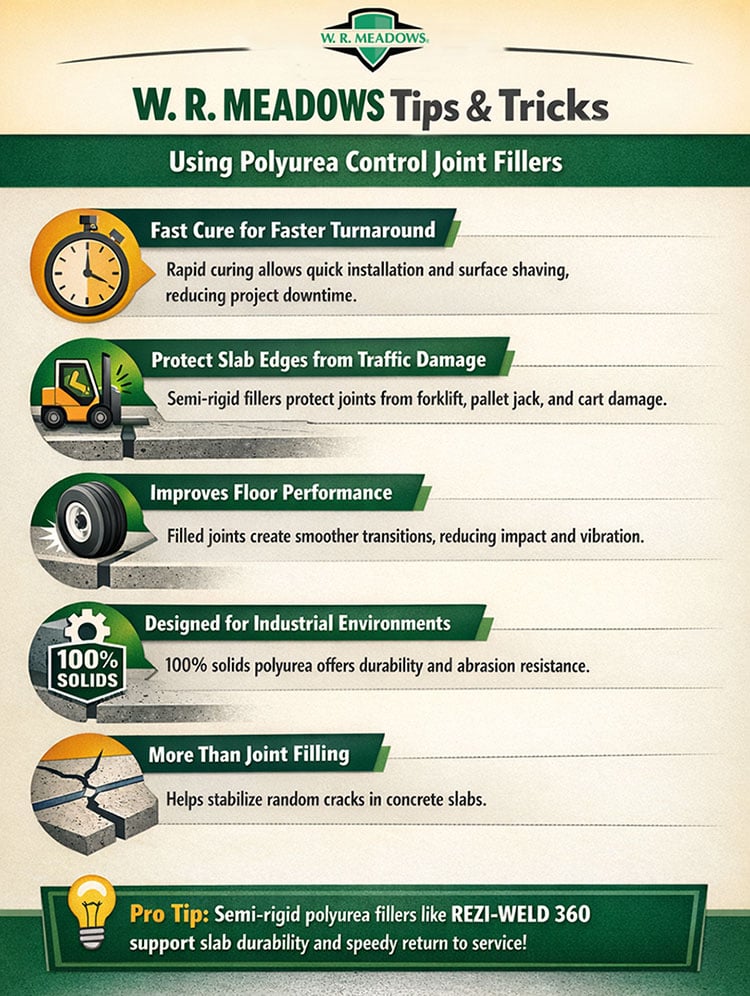
Using Polyurea Control Joint Fillers
- Fast Cure for Faster Turnaround – Polyurea joint fillers cure rapidly, allowing contractors to move quickly from installation to final surface shaving and reducing project downtime.
- Protect Slab Edges from Traffic Damage – Semi-rigid fillers support joint edges and help reduce spalling caused by forklifts, pallet jacks, carts, and other wheeled equipment.
- Improves Floor Performance – Filled joints help create smoother wheel transitions across slabs, reducing impact and vibration in busy facilities.
- Designed for Industrial Environments – 100% solids polyurea technology provides dimensional stability, abrasion resistance, and consistent hardness for demanding floor conditions.
- More Than Joint Filling – Semi-rigid polyurea materials can also help stabilize interior random cracks in horizontal concrete slabs.
Pro Tip: Semi-rigid polyurea fillers such as REZI-WELD 360 help support slab durability while enabling efficient installation and rapid return to service.
Request More Information
To contact your local W. R. MEADOWS representative or for general correspondence, please click here. If you need immediate assistance, please call (800) 342-5976. Thank you!


