
 Canada
 Français
 Español
 International
And Why HRM 714 from W. R. MEADOWS is the Benchmark Solution
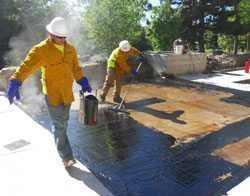 Green roofs hold a unique position in today’s-built environment. They are more than an architectural feature; they are a technical solution to the growing performance demands placed on buildings. A properly designed vegetative roof can reduce stormwater runoff, lower energy loads, extend service life, and contribute meaningfully to urban sustainability. But all of these benefits rest on one component hidden beneath layers of specialized soil, drainage, and vegetation: the waterproofing membrane. If that element fails, remediation becomes disruptive and extremely costly. That’s why specifying a system with a proven track record is non-negotiable.
THE DEMANDS OF GREEN ROOF
Unlike conventional roofing, which is designed to shed water rapidly, a green roof holds moisture in its overburden. This creates a demanding environment for waterproofing: the membrane is exposed to constant hydrostatic pressure, high humidity, root intrusion, and extreme temperature swings. Once covered, inspection or repair is nearly impossible without removing the entire assembly. Contractors and owners must therefore rely on a system engineered to endure decades of these unique stresses without compromising performance.
For more than half a century, hot-rubberized asphalt (HRA) has been the benchmark material in this setting. While alternative membranes (cold-applied fluids, synthetics, or sheet goods) have entered the market, none have demonstrated the same combination of reliability, resilience, and longevity under the conditions imposed by vegetative assemblies.
WHY HOT-RUBBERIZED ASPHALT ENDURES
The performance of HRA starts with its application. Heated to the proper temperature, it becomes a viscous liquid that fully conforms to the substrate, filling every irregularity and surrounding every penetration. When it cools, it solidifies into a seamless, elastomeric barrier with no laps or joints to become weak points. This monolithic bond is fully adhered, preventing lateral water migration, one of the most difficult leaks to diagnose once the system is buried.
Equally important are its mechanical properties. HRA membranes are formulated with high elongation and flexibility, allowing them to bridge minor structural cracks and accommodate thermal movement without splitting. They remain resilient in both freezing winters and hot summers, resisting embrittlement and maintaining elasticity across a wide temperature range. The rubberized composition also provides resistance to puncture and root intrusion, both critical factors beneath a green roof.
Field performance speaks louder than any lab test. For decades, HRA membranes have protected critical structures (plazas, podiums, parking decks, and vegetative roofs) under some of the harshest service conditions. That history of performance builds confidence for specifiers, reduces liability for contractors, and reassures owners that the system will protect their investment for decades.
HRM 714: W. R. MEADOWS’ BENCHMARK
Within this proven category, HRM 714 from W. R. MEADOWS has become a benchmark solution. It is engineered to achieve the delicate balance between fluidity during application and resilience in service. Heated properly, it flows evenly, achieving a continuous bond to the primed substrate. Once cured, it retains elastomeric properties, accommodating minor deck movement and bridging cracks without failure.
One of its most defining advantages is adhesion. Because HRM 714 is fully bonded, water cannot travel undetected beneath the membrane even under sustained hydrostatic pressure. Any breach remains localized and identifiable rather than spreading invisibly across the deck. This containment characteristic is a significant benefit in buried assemblies, where diagnostic testing and repair options are otherwise limited.
Durability is another strength. HRM 714 maintains flexibility through years of exposure to heat, cold, and constant moisture. Its rubberized formulation resists punctures, ensuring long-term performance beneath heavy soil and vegetation. When integrated into a complete W. R. MEADOWS system (including protection boards, drainage composites, and appropriate root barriers) HRM 714 becomes part of a continuous defense designed for compatibility and long service life.
Contractors who install HRM 714 also note its efficiency. Once the kettle is properly managed, the material spreads quickly across large areas and readily flows into edges and corners. The resulting cured film provides robust thickness and puncture resistance, a necessity under soil, stone, or pavers. While installation requires heat and handling care, the long-term return is measured in decades of service with minimal maintenance.
A SYSTEM APPROACH
For distributors, HRM 714 represents more than a single SKU. It anchors a system of compatible solutions from W. R. MEADOWS that includes protection courses, root barriers, paver systems, and XPS insulation. Because green roofs are specification-driven projects with little room for improvisation, being able to offer a complete integrated package is an advantage for both procurement and project execution. Compatibility across all layers reduces risk, simplifies bidding, and increases confidence in the final assembly.
SUSTAINABILITY & LONG-TERM VALUE
Green roofs are, by definition, a sustainability strategy. They manage stormwater, lower carbon footprints, and improve the urban landscape. But these benefits only hold if the underlying waterproofing lasts. A failed membrane not only negates the ecological benefits but also adds waste and cost through premature repairs. HRM 714 supports the intent of green roofs by extending structural service life, preventing water intrusion, and minimizing the need for costly interventions. In short, it underpins the very sustainability goals the design is meant to achieve.
WHY CONTRACTORS & DISTRIBUTORS CONTINUE TO TRUST HRA
When evaluating waterproofing for green roofs, alternatives may appear attractive on paper, but field performance tells the story. Hot-rubberized asphalt has proven its reliability under the unique demands of vegetative assemblies in a way no other category has consistently matched. Its monolithic adhesion, resilience under movement and temperature extremes, and long-term track record make it the standard by which others are judged.
HRM 714 embodies these advantages while offering contractors and distributors the additional assurance of system integration and decades of successful use. For the installer, it means fewer risks and callbacks. For distributors, it provides a product line with steady demand and proven performance. For building owners and architects, it ensures that the green roof, an investment in both sustainability and aesthetics, rests on a foundation that will endure.
The success of a green roof is measured not just in how it looks or how it functions in its first years, but in its ability to last. Beneath every thriving rooftop garden, HRM 714 delivers permanence, performance, and peace of mind. That is why hot-rubberized asphalt remains the gold standard, and why HRM 714 continues to define the benchmark for green roof waterproofing.
Request More Information
To contact your local W. R. MEADOWS representative or for general correspondence, please click here. If you need immediate assistance, please call (800) 342-5976. Thank you!


