
 Canada
 Français
 Español
 International
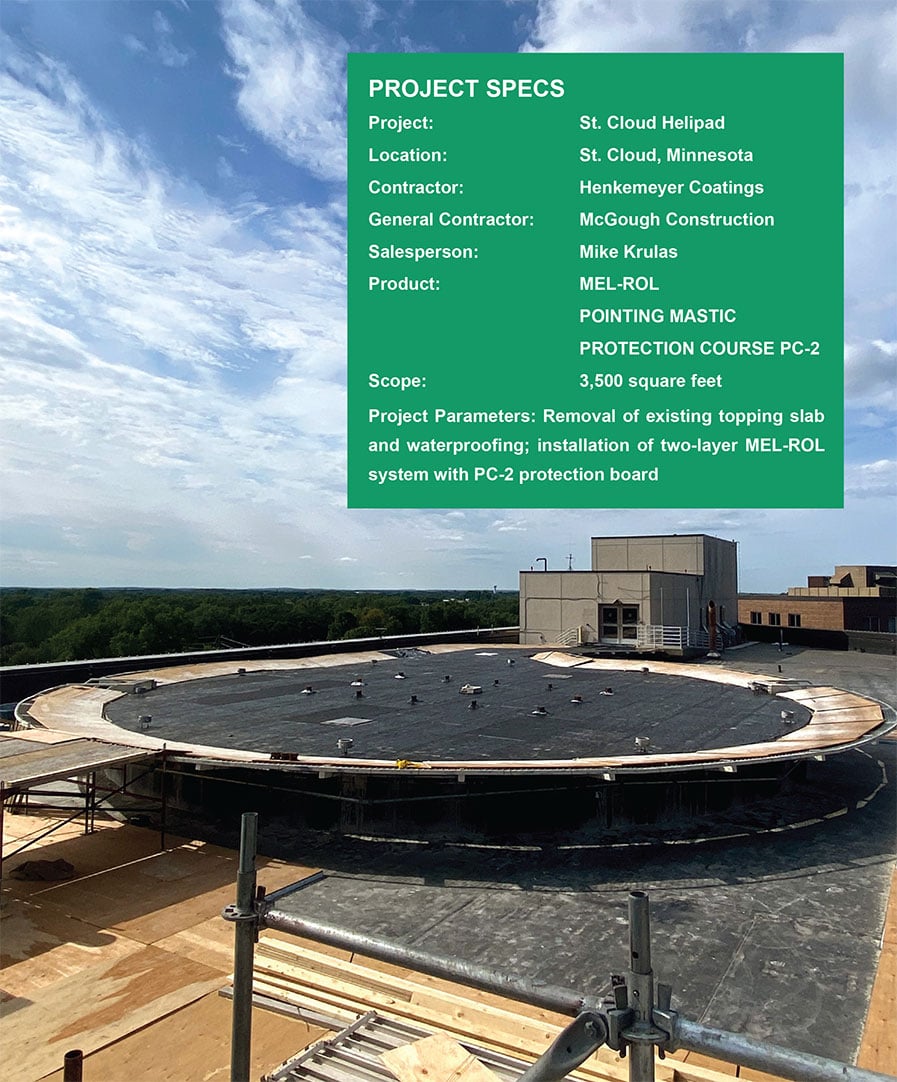
At most hospitals, the helipad isn’t just another structural feature, it’s a lifeline. Every landing carries patients in critical condition, and every minute of downtime can affect lives. That reality set the stage for the St. Cloud, Minnesota hospital project, where the main rooftop helipad and walkway required significant repairs. The challenge was straightforward on paper but complex in practice: remove damaged concrete and its underlying waterproofing, then install a robust, redundant system that would protect the structure for years to come, all while the hospital’s main helipad was shut down for only one week.
This was no ordinary waterproofing assignment. The elevated location, tight deadlines, and sensitive environment demanded careful planning, seamless coordination, and complete trust in the products being applied.
Henkemeyer Coatings, a contractor with decades of experience in painting and waterproofing, was invited to the project by McGough Construction, a general contractor with whom they share a long-standing relationship.
Together, and with the support of W. R. MEADOWS’ technical representative, Mike Krulas, the team delivered a solution that not only met the strict timeline but also demonstrated how communication and collaboration can turn a high-pressure job into a textbook success story.
BACKGROUND: FROM PAINTING TO WATERPROOFING EXPERTS
Henkemeyer Coatings has been part of Minnesota’s construction scene since 1980, when it began as a commercial painting company. Nearly thirty years later, in 2011, the company expanded into waterproofing and air barriers, bringing with it the precision and attention to detail learned from years of surface preparation and coatings work. Today, their portfolio includes projects across schools, hospitals, and large-scale commercial developments, with waterproofing becoming a specialty that clients and general contractors rely on.
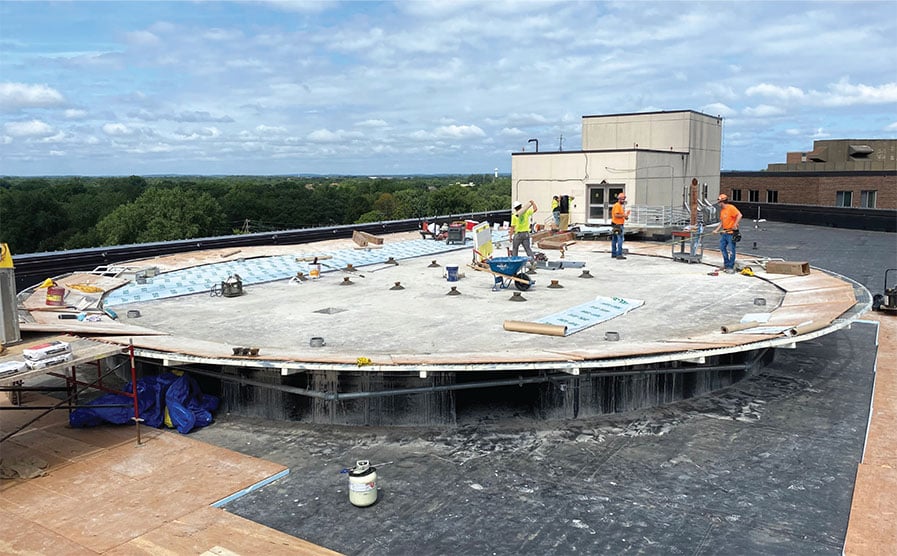
 By the time of the St. Cloud Hospital project, Henkemeyer had over a decade of experience with waterproofing and a strong preference for W. R. MEADOWS products, particularly sheet-applied membranes like MEL-ROL. The company had used these systems repeatedly, building both confidence in their performance and familiarity with installation methods. When McGough Construction approached them to handle the helipad retrofit, their response was straightforward: MEL-ROL was the right choice.
WHY THE RETROFIT WAS NEEDED
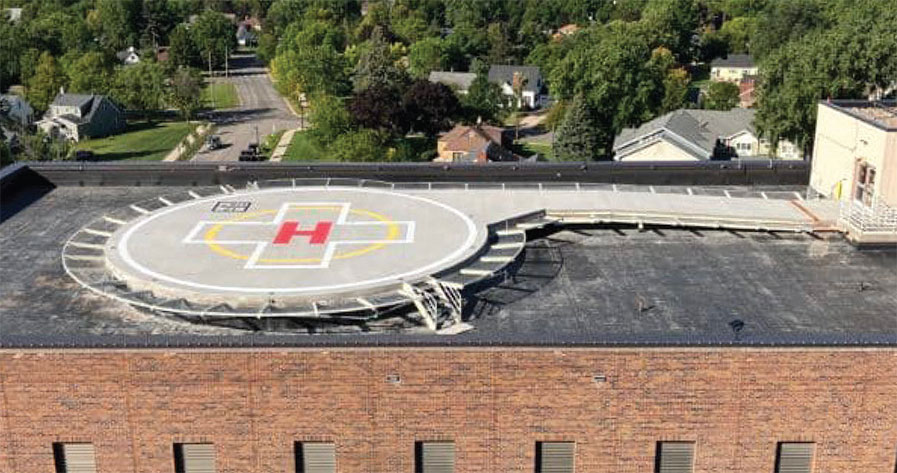
Unlike many waterproofing jobs that start from scratch on new construction, this project involved retrofitting an existing structure. The helipad’s topping slab, along with the connecting walkway, had deteriorated to the point where replacement was necessary. Demolition was unavoidable, but once heavy equipment began breaking up the old concrete, the underlying waterproofing would be damaged beyond repair. That meant the project wasn’t simply about replacing concrete; it was about creating a completely new waterproofing system beneath it, one that could withstand not just weather but also the heavy use and traffic associated with a hospital rooftop.
The existing system had been a sheet-applied product from an unknown manufacturer. It had performed adequately up to that point, but once demolition began, it couldn’t be salvaged. Henkemeyer’s crews anticipated this from the start and planned accordingly, ensuring they would arrive on-site ready to install a fresh system as soon as the substrate was prepared. That foresight allowed them to move quickly without wasting time deciding whether the old waterproofing could be saved.
THE IMPORTANCE OF COMMUNICATION & SCHEDULING
Shutting down a hospital’s main helipad is no small matter. Every day the structure was offline meant helicopters had to divert elsewhere, adding time to emergency responses. The team was given just one week to complete their scope of work—a deadline that could not slip. To make that happen, Henkemeyer and McGough instituted daily coordination meetings where progress was reviewed, challenges were flagged, and solutions were agreed upon in real time.
For Henkemeyer, this approach made all the difference.
If you don’t have good communication and you run into issues, you can lose a lot of time waiting for answers,” said Ryan Gotfredson, Henkemeyer Project Manager. “On this project, there was never that problem. Every unknown was discussed immediately, and we kept moving.”
The compressed schedule also shaped product selection. With no formal specification in place, the decision was left to the design-build team. Henkemeyer submitted MEL-ROL because it was familiar, proven, and consistent. They knew their crews could install it efficiently and without surprises, a critical factor when working under a one-week shutdown.
INSTALLING A REDUNDANT SYSTEM
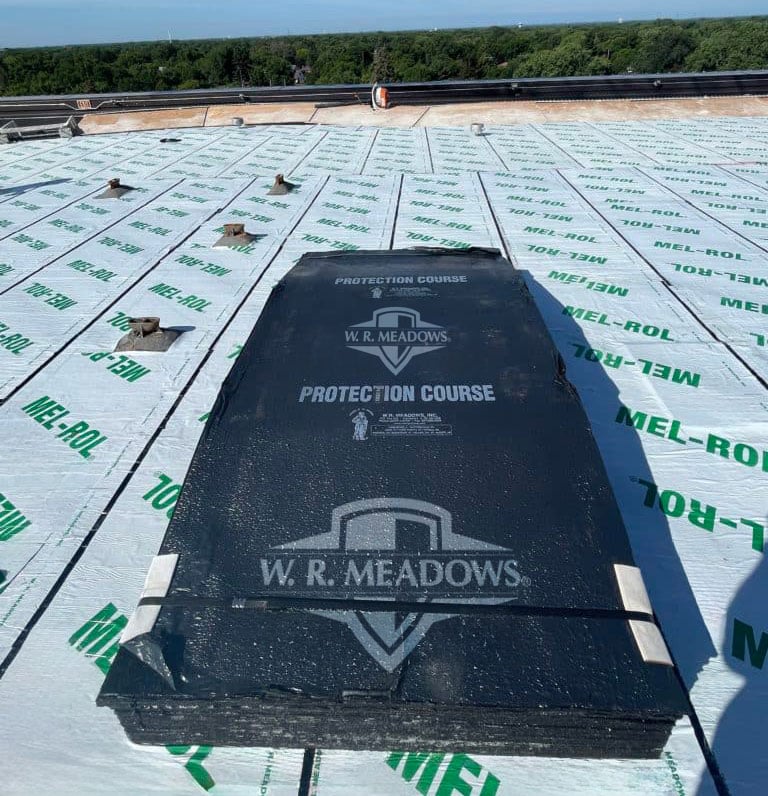
The waterproofing design called for not one but two layers of MEL-ROL, applied perpendicular to one another. While a single layer would have met baseline performance requirements, redundancy was encouraged by W. R. MEADOWS for horizontal applications where access after construction would be difficult. In a setting as sensitive as a hospital rooftop helipad, the added protection provided peace of mind for both the contractor and the owner.
The process began with thorough cleaning of the prepared substrate, followed by priming with MEL-PRIME. The first layer of MEL-ROL was then applied and rolled to ensure complete adhesion. Another coat of primer was added before the second layer of MEL-ROL was installed at a cross angle to the first, reducing the chance of aligned seams. End terminations were reinforced with POINTING MASTIC, and the entire system was capped with an additional primer coat. Finally, the crew installed PC-2 PROTECTION COURSE, chosen for its ability to withstand construction traffic and the placement of a new concrete topping slab.
This step was critical because while drainage boards might be appropriate for some horizontal waterproofing applications, they were not suited for this one. With concrete being poured directly over the system and workers moving heavily across the surface, a durable protection layer was the only logical choice.
ON-SITE CHALLENGES & HOW THEY WERE MANAGED
Even the best-laid plans encounter challenges. On this project, one of the most persistent issues was keeping other trades off the MEL-ROL before the protection course was in place.
We did our best to make sure nobody stepped on it,” recalled Gotfredson. “It wasn’t always easy, but everyone knew the stakes and respected the work.”
Working at elevation also brought its quirks. Strong winds made managing debris a constant concern, particularly the paper backings from the sheet membrane. Crews had to be diligent about collecting scraps immediately to prevent them from blowing off the roof and into the surrounding area.
Material handling could have posed another major hurdle. Transporting large quantities of rolls, primers, mastic, and protection board to a rooftop often complicates logistics. Fortunately, McGough arranged for a crane to deliver materials directly to the work area, reducing labor and saving time.
The removal of the old waterproofing also went smoothly. Crews used a riding floor scraper to peel away the remnants, exposing a substrate that was quickly readied for the new system. By anticipating that the old system would be damaged, they avoided the wasted effort of trying to salvage it.
THE VALUE OF TRUSTED PRODUCTS & SUPPORT
A recurring theme in this project was the importance of using products the crew trusted. Henkemeyer’s team had been working with MEL-ROL for nearly a decade and appreciated not only its performance but also its usability. The white film on the sheet, for example, made a noticeable difference during hot summer months compared to traditional black membranes, easing installation for field workers.
Consistency was another factor.
It’s advantageous for our workers to use products they’re familiar with,” said Gotfredson. “W. R. MEADOWS products are reliable in how they’re delivered and how they perform, which makes planning and execution much easier.”
Behind that consistency was the support of W. R. MEADOWS’ representative, Mike Krulas. Known for his responsiveness, Krulas made himself available for questions throughout the process. “With Mike, you always get an answer right away,” said Gotfredson. “That’s not always the case with other reps. That kind of support keeps projects moving.”
LESSONS FOR CONTRACTORS
For contractors considering similar projects, the St. Cloud helipad retrofit offers several valuable lessons. First, communication is everything. Daily meetings prevented small issues from becoming costly delays, and all stakeholders stayed aligned on goals and schedules. Second, redundancy pays off. Adding a second layer of MEL-ROL may not have been strictly required, but it provided long-term assurance against failure in a critical application. Third, protection of the membrane is as important as its installation. Keeping trades off until the protection course was in place preserved the integrity of the system. Finally, familiar products reduce risk. When schedules are compressed, crews need to work with systems they know will perform without surprises.
RESULTS & REFLECTIONS
In the end, the project was completed within the strict one-week shutdown window, and the helipad was returned to service on schedule. The waterproofing system is now protected beneath a new topping slab, designed to provide durable service for years to come. The hospital was satisfied, the general contractor praised the smooth execution, and Henkemeyer left knowing they had delivered a solution that combined both performance and reliability.
Everything went as planned,” reflected Gotfredson. “You can’t ask for anything better than that.”
For contractors and industry professionals, the project stands as a reminder of how preparation, collaboration, and trusted systems can turn a potentially high-risk retrofit into a straightforward success. It demonstrates that with the right partners and a clear plan, even complex projects in sensitive environments can be executed without delay, disruption, or compromise.
Request More Information
To contact your local W. R. MEADOWS representative or for general correspondence, please click here. If you need immediate assistance, please call (800) 342-5976. Thank you!