Canada
 Français
 Español
 International
Construction joint sealants are often viewed as a finishing trade detail, something installed near the end of a project once the structural and envelope systems are in place. In reality, they are a critical component of building envelope performance and long-term structural durability. When properly specified and installed, joint sealants serve as a primary line of defense against water infiltration, air leakage, vapor migration, and even sound transmission. When overlooked or misapplied, they can become one of the most common sources of building failure.
Every building moves. Concrete expands and contracts with temperature fluctuations. Steel shifts under load. Wood responds to changes in humidity. Even masonry assemblies experience dimensional changes over time. Without construction joint sealants that are specifically designed to accommodate movement, these normal and anticipated building shifts can open pathways for moisture and air intrusion. In commercial construction, infrastructure projects, tilt-up buildings, parking structures, swimming pools, wastewater facilities, and large warehouse slabs, joint sealants are not optional accessories. They are engineered materials designed to protect the integrity of the building envelope.
Protecting Against Water Infiltration and Moisture Damage
The primary purpose of a construction joint sealant is to seal joints and penetrations while allowing for expansion and contraction. Unlike rigid fillers, high-performance elastomeric joint sealants remain flexible throughout their service life. This flexibility allows them to stretch and compress with the joint while maintaining adhesion to the substrates on either side. That adhesion is critical. If a sealant loses its bond to the joint interface, water and air can infiltrate the structure, potentially leading to corrosion of reinforcing steel, deterioration of structural components, freeze-thaw damage, and mold growth inside the building envelope.
Moisture intrusion is one of the most costly and disruptive issues in modern construction. Water that penetrates a building envelope can damage insulation, rust structural steel, stain interior finishes, and create ideal conditions for mold. Once mold develops, remediation can be expensive and may expose building owners and contractors to legal risk. Construction joint sealants provide a continuous barrier at transitions and joints, helping to prevent these failures before they begin. In this way, sealants support the performance of air barrier systems, vapor retarder systems, and waterproofing assemblies by maintaining continuity where materials meet.
Accommodating Building Movement in Commercial Construction
The importance of joint sealants becomes even more apparent when examining large-scale projects. In tilt-up construction, concrete wall panels are cast on site and then lifted into position. The vertical joints between panels must be sealed to prevent water and air infiltration. In distribution centers and warehouse facilities that may exceed one million square feet, the number of expansion and control joints in the slab can be substantial. Each of those joints represents a potential entry point for water and debris if not properly sealed. The cumulative impact of sealant performance across such expansive surfaces cannot be overstated.
Infrastructure projects such as highways, airport runways, bridges, and sidewalks also rely heavily on expansion joints and joint sealants. Long expanses of concrete cannot perform without properly spaced joints to accommodate thermal movement. Sealants in these environments must withstand vehicular traffic, temperature extremes, UV exposure, and moisture. In wastewater treatment facilities and swimming pool applications, sealants may be exposed to submersion, chemicals, and fluctuating hydrostatic pressures. These demanding conditions highlight why selecting the appropriate sealant chemistry and movement capability is essential for performance and durability.
Supporting Structural Durability and Service Life
Construction joint sealants also serve a structural protection function. By preventing water intrusion into concrete joints, sealants help protect reinforcing steel from corrosion. Corroded rebar expands as it rusts, creating internal pressure that can crack and spall concrete. Over time, this deterioration can compromise structural integrity and shorten the service life of the structure. Properly installed sealants reduce the likelihood of water reaching embedded steel, thereby supporting the long-term performance that engineers and owners expect from their designs.
The service life of high-performance elastomeric joint sealants can range from ten to twenty years, depending on chemistry and exposure conditions. That longevity is only achievable when the sealant is selected appropriately and installed according to best practices. Movement capability must match anticipated joint movement. Adhesion must be maintained at the joint interface. Proper joint geometry, including width-to-depth ratios and backing materials, must be observed. When these principles are followed, joint sealants deliver durable performance that protects the building envelope for years.
Enhancing Energy Efficiency and Indoor Comfort
Beyond moisture control, joint sealants contribute to energy efficiency and occupant comfort. Air leakage through poorly sealed joints can increase heating and cooling loads, reduce indoor comfort, and compromise the effectiveness of air barrier systems. Vapor migration can lead to condensation within wall assemblies, contributing to insulation degradation and mold risk. Sealants that function as part of an air barrier and vapor retarding system help maintain environmental control within the building enclosure.
In commercial and institutional construction, maintaining indoor environmental quality is increasingly important. Properly sealed joints help reduce uncontrolled air infiltration, support energy code compliance, and enhance overall building performance.
A System Approach for Distributors and Contractors
For distributors, understanding the performance role of construction joint sealants elevates the conversation with contractors and specifiers. Rather than positioning sealants as commodity products selected primarily on price, distributors can provide value by guiding customers toward materials that meet the movement capability, substrate compatibility, and environmental exposure requirements of the project. For contractors, recognizing the critical nature of joint sealants reinforces the importance of proper joint design, surface preparation, backing material selection, and installation technique. A well-designed sealant joint that is poorly prepared or improperly installed will not perform as intended.
Ultimately, construction joint sealants represent a small percentage of total construction cost, yet they have an outsized impact on building performance. They are the flexible bridge between rigid materials, the safeguard at transitions, and the barrier that keeps water, air, and vapor where they belong. For construction professionals committed to long-term durability, structural protection, and building envelope performance, joint sealants should be treated as critical system components rather than afterthoughts. By prioritizing proper specification, product selection, and installation, contractors and distributors alike can help ensure that the structures they build and supply reach the life expectancy they were designed to achieve.
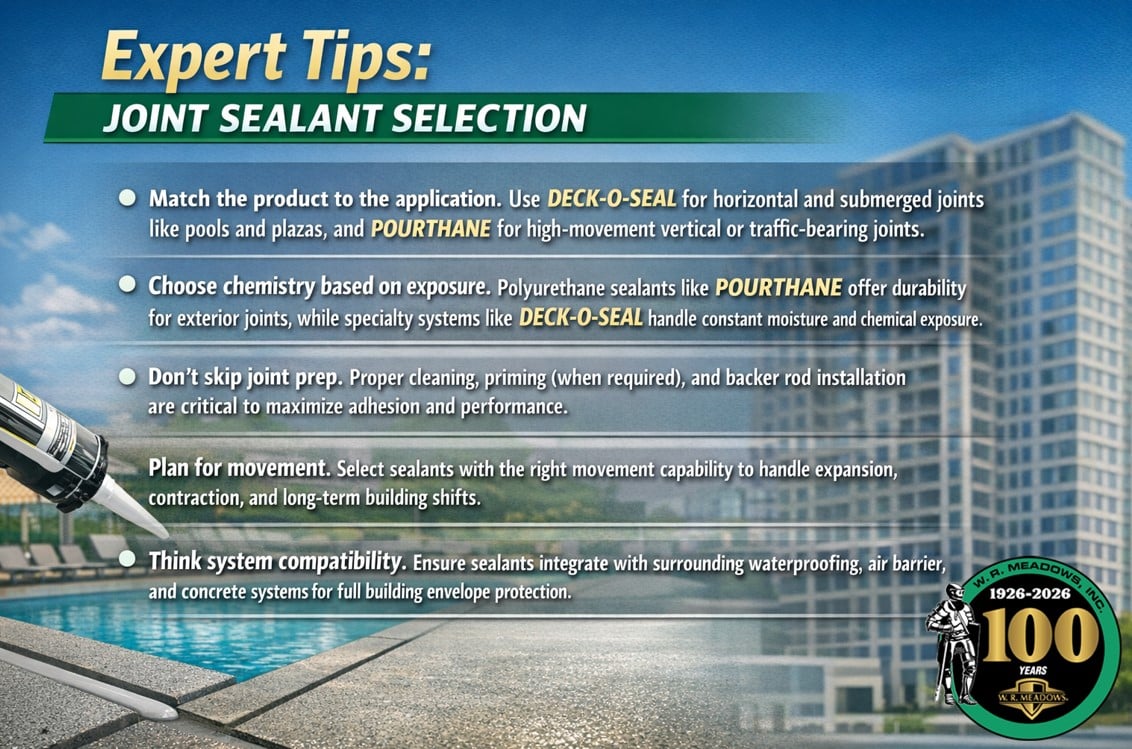
Expert Tips: Joint Sealant Selection
- Match the product to the application. Use DECK-O-SEAL for horizontal and submerged joints like pools and plazas, and POURTHANE for high-movement vertical or traffic-bearing joints.
- Choose chemistry based on exposure. Polyurethane sealants like POURTHANE offer durability for exterior joints, while specialty systems like DECK-O-SEAL handle constant moisture and chemical exposure.
- Don’t skip joint prep. Proper cleaning, priming (when required), and backer rod installation are critical to maximize adhesion and performance.
- Plan for movement. Select sealants with the right movement capability to handle expansion, contraction, and long-term building shifts.
- Think system compatibility. Ensure sealants integrate with surrounding waterproofing, air barrier, and concrete systems for full building envelope protection.
Request More Information
To contact your local W. R. MEADOWS representative or for general correspondence, please click here. If you need immediate assistance, please call (800) 342-5976. Thank you!