
 Canada
 Français
 Español
 International
A practical guide to prioritizing asphalt pavement maintenance when budgets are limited
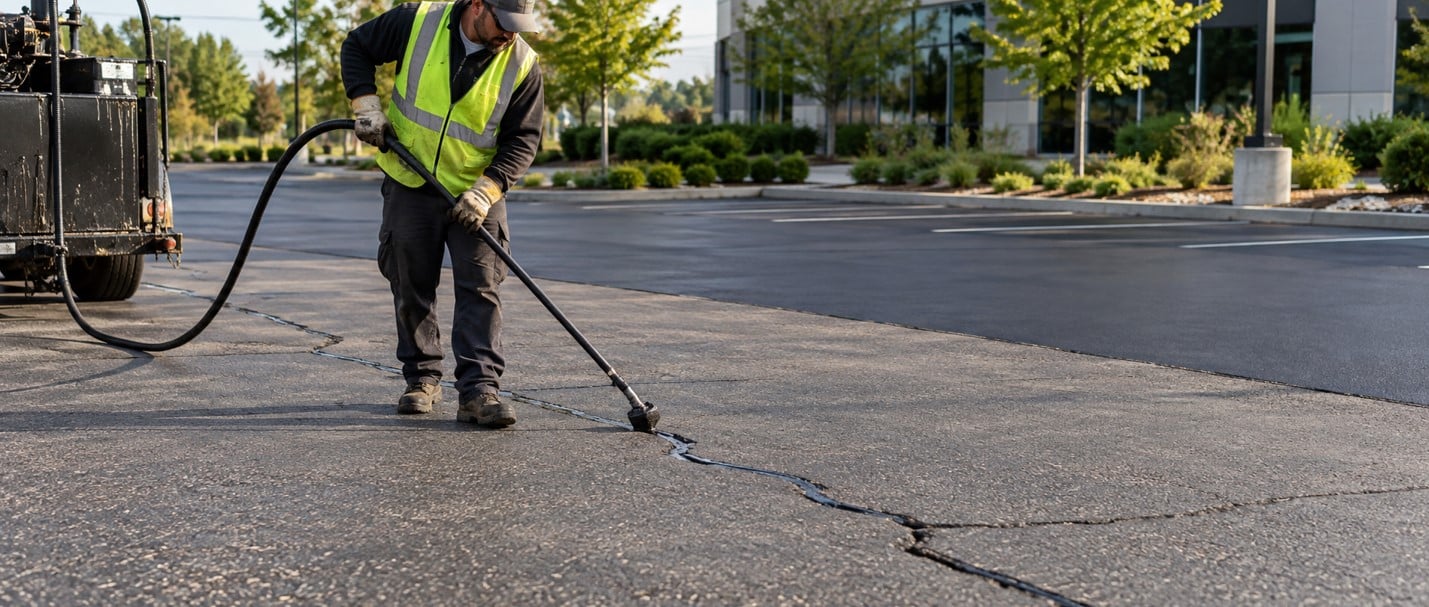
If You Could Choose Only One
Crack sealing and sealcoating are both valuable asphalt pavement preservation treatments, but they solve different problems. If a pavement has suitable cracks and the maintenance budget can fund only one treatment, crack sealing should generally come first. It addresses a direct pathway for water to enter the pavement system. Sealcoating protects and renews the exposed surface, but it does not replace a properly installed crack seal.
That answer needs one important qualification: maintenance decisions should be based on actual pavement condition. An oxidized but largely uncracked surface may benefit more directly from sealcoating. Pavement with widespread fatigue cracking, deep rutting, base failure, or numerous potholes may be beyond the point where either treatment can solve the underlying problem. The goal is not to choose a favorite product category. It is to match the treatment to the distress while the pavement is still a good candidate for preservation.
How Water Turns a Crack Into a Larger Pavement Problem
Asphalt pavement is a layered system. The wearing surface distributes traffic loads, but its performance also depends on the aggregate base, subbase, and subgrade beneath it. Once a crack opens at the surface, rainfall, melting snow, and runoff can move below the asphalt. If drainage is limited, the supporting materials can remain wet and lose stiffness or stability.
Traffic then acts on a pavement structure that is providing less uniform support. Repeated wheel loads can widen cracks, loosen material along crack edges, and contribute to depressions or potholes. In cold climates, freeze-thaw cycling can intensify the damage as trapped moisture freezes, expands, and thaws. Water can also contribute to stripping, in which asphalt binder loses adhesion to aggregate. What begins as a narrow surface opening can therefore become a system-level deterioration mechanism.
Crack sealing interrupts that pathway. A properly selected, installed, and bonded sealant is designed to limit the entry of water and incompressible debris while accommodating the expected movement of the crack. This is why timely crack treatment can have greater preservation value than simply covering the pavement with a surface coating after open cracks have developed.
What Sealcoating Does and Why It Still Matters
Sealcoating is a preventive surface treatment. It creates a renewed wearing surface that can help slow oxidation and weathering, reduce the loss of fine material, and improve pavement appearance. A uniform dark surface can also improve contrast for new pavement markings. Depending on the formulation and service environment, a sealcoat may provide additional resistance to incidental exposure from water, sunlight, and certain fluids.
Its limitation is equally important: a sealcoat is not designed to bridge and waterproof significant working cracks. Applying sealcoat over untreated cracks may make a property look improved at first, but the cracks can remain pathways for moisture or reappear through the coating. Sealcoating performs best when structural repairs and appropriate crack treatment have already been completed and the pavement is in a maintainable condition.
The Correct Sequence for a Combined Maintenance Program
When both treatments are appropriate, crack sealing should be completed before sealcoating. A sound sequence begins with a pavement condition survey. Identify crack patterns, potholes, failed patches, drainage concerns, oil contamination, raveling, oxidation, and areas of possible base failure. Do not treat every line in the pavement as the same type of distress.
Next, complete repairs that a surface treatment cannot accomplish. Replace failed pavement where necessary, repair potholes, address drainage problems, and clean contaminated areas. Prepare and seal eligible cracks in accordance with the manufacturer’s instructions and project requirements. Allow the material to cool or cure as required and confirm compatibility before sealcoating. Protect the finished work from traffic for the specified period and restore pavement markings when needed.
The interval between crack sealing and sealcoating is not universal. It depends on the crack-seal material, sealcoat chemistry, weather, surface condition, and manufacturer recommendations. Scheduling should account for pavement and air temperatures, forecast precipitation, humidity, traffic control, and the time needed for each material to develop suitable performance before the next operation.
When the Budget Forces a Choice
Limited budgets make prioritization essential. Start by asking which untreated condition creates the greatest risk of accelerating deterioration. If open, sealable cracks are allowing water into an otherwise serviceable pavement, crack sealing usually deserves priority. The treatment is targeted at a specific defect and can help preserve the support system beneath the surface.
If the pavement is sound and largely free of meaningful cracks but shows early oxidation, color loss, or minor surface wear, sealcoating may be the more relevant treatment. If the pavement exhibits interconnected fatigue cracking, unstable patches, severe deformation, or recurring potholes, preserve the budget for investigation and corrective repair rather than expecting a surface treatment to compensate for structural distress.
This condition-based approach also helps owners avoid spending limited funds evenly across every paved area. Higher-priority zones may include entrances, drainage paths, loading areas, turning lanes, pavement edges, and locations where cracks are expanding. Treating the right areas at the right time can provide more value than applying the same treatment everywhere.
Common Reasons Pavement Treatments Underperform
Good materials cannot overcome poor diagnosis or installation. Crack sealants may lose adhesion when cracks contain dust, moisture, vegetation, or loose material. Improper heating can damage some hot-applied materials, while inadequate heating can affect flow and bonding. Incorrect application geometry can leave too little material to accommodate movement or too much material on the surface, where traffic may track or damage it.
Sealcoats can underperform when applied to dirty, unstable, moisture-laden, or badly deteriorated pavement. Heavy application is not automatically better; excessive material can cure slowly or create an undesirable surface. Opening the area to traffic too soon, applying outside recommended weather conditions, or ignoring compatibility between treatments can also reduce performance. Manufacturer instructions, project specifications, and experienced application practices should guide the work.


Protect the Pavement From the Inside Out and the Outside In
Crack sealing and sealcoating should not be viewed as competing versions of the same treatment. Crack sealing protects the pavement from the inside out by closing pathways into the pavement system. Sealcoating protects from the outside in by helping preserve the exposed surface. Used together, at the appropriate stage of pavement life, they form complementary parts of a preventive maintenance strategy.
When cracks are present and the pavement remains a suitable candidate, address them before investing in surface appearance. When the surface needs protection and the cracks and repairs have been properly handled, sealcoating can complete the maintenance program. When distress points to structural failure, step back and select a repair that addresses the real cause.
W. R. MEADOWS offers pavement maintenance solutions for crack and joint sealing and other pavement distress repairs. Product selection and installation should always be based on pavement condition, anticipated movement, service environment, applicable specifications, and current product instructions.
PREVENT. PROTECT. PRESERVE.

Request More Information
Please complete the form below and a representative will be in touch with you shortly. If you need immediate assistance, please call (800) 342-5976. Thank you!
 Your Privacy is Protected.
Privacy Policy | Terms of Use