Canada
 Français
 Español
 International
Co-authored by Christian Warren of W. R. MEADOWS.
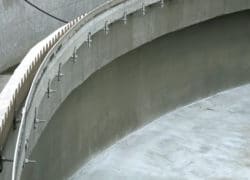
Crystalline cementitious coatings are advanced waterproofing materials designed to protect concrete structures by forming insoluble crystals within the concrete matrix. These crystals block the pathways through which water and other aggressive agents might travel, effectively sealing the concrete from within. Though several manufacturers produce these coatings, identifying when and how to use them properly requires a solid understanding of concrete behavior, application methods, and project requirements.
The Science Behind Crystalline Technology
Crystalline coatings are typically applied to concrete in slurry or dry-shake form. When moisture is present, proprietary chemicals in the coating react with the by-products of cement hydration, such as calcium hydroxide. This reaction forms long, needle-like crystals that fill capillaries, micro-cracks, and pores in the concrete. The result is a dense internal structure that significantly reduces water permeability. Unlike surface-level waterproofers, crystalline coatings penetrate deeply and remain dormant until water re-enters, at which point the crystallization process reactivates.
Proper Use Cases
Crystalline cementitious coatings are best suited for below-grade and water-retaining concrete structures. These include:
- Foundations and basements
- Water tanks and reservoirs
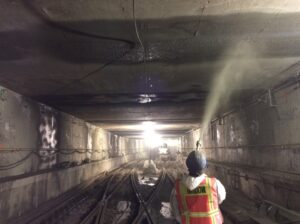
- Tunnels and subways
- Sewage and wastewater treatment plants
- Elevator pits and utility vaults
- Parking garages
They are especially useful in areas with hydrostatic pressure or recurring moisture exposure, as their self-sealing nature provides long-term durability and leak resistance.
Identifying the Right Conditions for Application
To determine whether a crystalline coating is appropriate for a specific project, several factors must be considered:
- Concrete Substrate Quality
The concrete should have a minimum strength of around 20 MPa (about 3000 psi). If the concrete is too weak, porous, or deteriorated, it may not allow the coating to penetrate effectively or facilitate the necessary chemical reactions. In such cases, repair or surface preparation may be required prior to application. - Moisture Availability
Crystalline coatings rely on water to activate their chemical reaction. Therefore, they should be applied to damp, not dry or SSD (saturated surface dry) surfaces. On freshly cast concrete, this typically means waiting until the concrete has cured sufficiently (often at least 7–10 days) but is still capable of retaining moisture. On older concrete, pre-wetting is necessary to provide the activation environment. - Surface Preparation
A clean, open-pore surface is essential. All contaminants, including oil, grease, laitance, curing compounds, and loose debris, must be removed. Mechanical preparation methods like sandblasting, water blasting, or grinding to a minimum CSP 3 may be employed to ensure proper adhesion and penetration. - Structural Movement
Crystalline coatings are not designed to bridge active cracks or joints with significant movement. While they can seal hairline cracks (up to about 0.5 mm), active joints should be treated with flexible sealants or flexible polymer-modified waterproofing membranes as complementary measures. Crystalline’s should be limited to static, non-moving concrete structures. - Application Environment
Temperatures should be within the recommended range (typically 40°F to 90°F) during and after application. Freezing conditions can halt crystallization and compromise performance. In hot weather, additional precautions like surface dampening or sun shading may be necessary to prevent premature drying.
Post-Application Care
After applying the crystalline coating, curing is crucial. Most manufacturers recommend moist curing for a minimum of 48 to 72 hours to facilitate ongoing crystal growth. This can be done by misting, covering with wet burlap, or applying a curing compound that does not interfere with the coating’s breathability.
Crystalline cementitious coatings offer a robust, self-healing solution for concrete waterproofing when used in the right conditions. By understanding the underlying chemical processes and evaluating site-specific factors such as moisture levels, substrate condition, and structural movement, contractors and engineers can confidently determine when and how to deploy these coatings. With correct application, these materials can enhance the durability, sustainability, and long-term performance of concrete infrastructure.
To request sample of W. R. MEADOWS products, including our CEM-KOTE line, please click here.
Resources

CEM-KOTE CW PLUS
CEM-KOTE CW PLUS is a single-component, cement-based crystalline waterproofing coating that provides both surface protection and deep, long-term moisture resistance.…

CEM-KOTE FLEX ST
CEM-KOTE FLEX ST is a highly flexible, fiber-reinforced, cementitious waterproofing coating designed for both positive- and negative-side protection of concrete…

CEM-KOTE FLEX CR
CEM-KOTE FLEX CR is a highly flexible, fiber-reinforced cementitious waterproofing coating engineered for concrete structures exposed to hydrogen sulfide and…

REINFORCING FABRIC HD
REINFORCING FABRIC HD is made of a high quality polymeric fiber with superior durability, resistance to Portland cement, and UV…
Cementitious Waterproofing
Advanced Technology to Protect Reinforced Concrete Structures GEMITE® The GEMITE line of polymer-modified cementitious coatings are designed to protect reinforced…

W. R. MEADOWS Acquires Gemite Products, Inc.
W. R. MEADOWS recently purchased GEMITE, the Canada-based construction chemicals innovator who created our Cem-Kote CW Plus and Cem-Kote Flex…
Request More Information
To contact your local W. R. MEADOWS representative or for general correspondence, please click here. If you need immediate assistance, please call (800) 342-5976. Thank you!