Canada
 Français
 Español
 International
Co-authored by Donnie Kruger of W. R. MEADOWS.
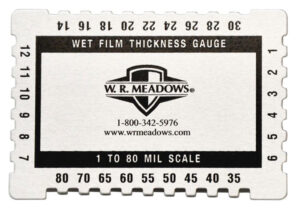 In construction, precision matters; especially when working with liquid-applied membranes designed to protect a structure from air and moisture intrusion. Whether you’re applying an air barrier, vapor barrier, or waterproofing membrane, ensuring the correct film thickness is one of the most important steps in achieving long-term performance. Even the best membrane system can underperform if it’s applied too thin or too thick.
That’s where the wet mil gauge, a small, comb-shaped tool, plays an essential role. It’s a simple, inexpensive device that provides immediate confirmation that a coating has been applied at the right thickness. Understanding how and why to use this tool can make all the difference between a membrane that performs as intended and one that falls short.
WHY THICKNESS MATTERS
Every liquid-applied membrane is engineered to perform within a specific range of dry film thickness once cured. That thickness directly impacts how well the membrane adheres, cures, and ultimately protects the building envelope.
When a coating is too thin, the membrane may fail to form a continuous film, creating weak spots or pinholes that compromise the barrier’s integrity. This can result in air or moisture infiltration and, ultimately, system failure. When applied too thick, the product may cure unevenly, form soft spots, or take longer to dry. Over-application can also reduce yield and increase costs, especially on large-scale projects. The goal is consistency; a uniform, monolithic layer applied according to the manufacturer’s specifications, to ensure proper curing and optimal barrier performance.
THE ROLE OF WET MIL GAUGES
A wet mil gauge, also called a wet film gauge, is a simple yet vital tool used to measure the thickness of a freshly applied liquid membrane. The tool features a series of notches or “teeth” of increasing height, typically measured in mils (where 1 mil equals 0.001 inch).
When pressed into the wet coating, the gauge allows the applicator to quickly determine the film’s thickness by observing which notches are coated with membrane material and which are not. This immediate feedback allows the applicator to make adjustments on the spot, before the membrane cures, helping to ensure the finished system meets the specified dry film thickness.
USING A WET MIL GAUGE: STEP-BY-STEP
While the concept is straightforward, correct usage is critical to obtaining accurate readings. Below is a practical field-level process:
- Select the correct gauge. Choose a gauge designed for the expected wet film range of the product being applied. Each W. R. MEADOWS product lists its recommended wet mil thickness on the data sheet.
- Inspect the gauge. Ensure the tool is clean, undamaged, and free from residual coatings that could alter readings.
- Apply the membrane. Apply the liquid membrane according to the product’s instructions, achieving even coverage across the surface.
- Take the measurement promptly. While the membrane is still wet, position the gauge at a 90° angle to the substrate.
- Insert and remove carefully. Press the notched edge straight into the coating until the teeth contact the substrate. Allow the coating to “wet” the teeth briefly, then lift the gauge straight up, maintaining the 90° angle, and avoid any sliding or dragging motion.
- Read the results. Observe the gauge to determine the highest tooth that is wet and the lowest that is not. The wet film thickness lies between those two values.
- Clean immediately. Wipe the gauge clean right after use to prevent the coating from hardening and affecting future readings.
This process only takes a few moments but provides invaluable information about application accuracy and quality.
QUALITY ASSURANCE & CONTROL
Wet mil measurements serve a dual purpose: they help applicators stay within specification and give QA/QC teams documentation that the job was performed correctly.
On some projects, verifying wet mil thickness is part of warranty compliance, as manufacturers and inspectors often require proof of proper application. Keeping detailed records of thickness readings helps confirm that product performance expectations have been met.
For the manufacturer, accurate application ensures that curing occurs properly and that the final film forms a durable, continuous layer. For the applicator, this small step prevents rework, reduces waste, and provides peace of mind knowing that the installation meets both performance and warranty standards.
THE BENEFITS EXTEND BEYOND VERIFICATION
The benefits of measuring wet mil thickness go beyond documentation. Once applicators become familiar with what “correct thickness” looks like, they can better maintain consistency across an entire project. This improves application efficiency and helps optimize material usage.
By understanding and controlling film thickness, crews can reduce over-application, extend material coverage, and improve cost efficiency. For large-scale installations, that adds up to significant savings without compromising performance.
THE BOTTOM LINE
Wet mil gauges may be small, but their impact is substantial. At W. R. MEADOWS, our membranes are designed with specific performance parameters that depend on accurate film thickness. Using a wet mil gauge is one of the simplest, most effective ways to confirm those parameters in real-world conditions.
Consistency in application is the key to durability and protection; and the wet mil gauge is one of the best tools to help you achieve both.
TIPS FROM THE FIELD: GETTING THE MOST OF YOUR WET MIL GAUGE
- Keep spares on hand. Gauges are inexpensive and easy to lose on a busy jobsite. Having extras prevents downtime.
- Take multiple readings. Measure in several locations to ensure uniform coverage, especially on large wall or deck sections.
- Document results. Recording readings as part of your daily log supports quality control and warranty documentation.
- Inspect before every use. Even slight bending or dried residue can affect accuracy.
- Follow the cure. After verifying wet film thickness, always check that the cured film aligns with expected dry mil specifications.
A few quick checks in the field can make the difference between a successful project and one that falls short. Precision, consistency, and attention to detail are what separate a good job from a great one; and the wet mil gauge is a simple, reliable way to achieve that every time.
Request More Information
To contact your local W. R. MEADOWS representative or for general correspondence, please click here. If you need immediate assistance, please call (800) 342-5976. Thank you!