Canada
 Français
 Español
 International
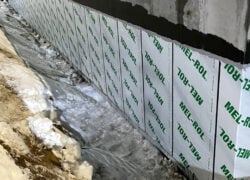
MEL-ROL is a sheet-applied, self-adhering waterproofing membrane designed to help protect below-grade foundations, walls, and slabs from unwanted water intrusion. Backed by W. R. MEADOWS’ system of compatible accessory products, MEL-ROL is built to simplify installation while offering reliable, positive-side waterproofing performance. It features a durable, 60-mil membrane that combines a polymeric waterproofing layer with a tough polyethylene carrier film.
This product is commonly used on foundations, basements, plaza decks, parking structures, and other areas where waterproofing is critical. MEL-ROL is easy to apply, even in low temperatures with special versions available, and works well with concrete, masonry, wood, and metal surfaces. Its overlap guideline and adhesive strips help ensure proper installation, while its flexibility and tested performance make it a dependable choice for a wide range of projects.
Data Sheets
Guide Specification
Application Details
MEL-ROL Waterproofing Membrane Video
MEL-ROL Animation
MEL-ROL Horizontal Application Tutorial
Product Data Sheet

| 07 13 26 |
|

MEL-ROL®
Rolled, Self-Adhering Waterproofing Membrane
DESCRIPTION
MEL-ROL waterproofing system is a flexible, versatile, dependable, bituminous, roll-type waterproofing membrane. It is a 60 mil-membrane composed of a nominally 56 mil thick layer of polymeric waterproofing membrane on a heavy duty, four-mil thick, cross-laminated polyethylene carrier film. The two components are laminated together under strict quality-controlled production procedures.
A handy overlap guideline is printed 2 ½” (63.5 mm) in from the material edge on each side to assure proper overlap coverage and to assist in maintaining a straight application. Special exposed polymeric membrane strips are provided on both sides for positive membrane-to-membrane adhesion in the overlap area. All components of the MEL-ROL waterproofing system work together to provide a cost-effective, positive waterproofing system that’s quick and easy to apply.
W. R. MEADOWS accessory products included in the MEL-ROL waterproofing system are: BEM, MEL-ROL LIQUID MEMBRANE, MEL-PRIME™ adhesive (solvent-based and water-based), POINTING MASTIC, DETAIL STRIP, TERMINATION BAR, PROTECTION COURSE and MEL-DRAIN™ drainage board.
USES
MEL-ROL waterproofing system provides a cost-effective answer to properly waterproof foundations, vertical walls, below-grade floors, and balcony structures in residential and commercial construction. It is equally effective for use as between-the-slab waterproofing on plaza decks, parking decks, and structural slabs. Use it as a waterproofing membrane to isolate mechanical and electronic rooms, laboratories, kitchens, and bathrooms. MEL-ROL offers positive protection when “wrapped around” major rapid transit, vehicular, utility, and pedestrian tunnel projects. MEL-ROL can also be used on insulated concrete forms (ICF). MEL-ROL can be applied to concrete, masonry surfaces, wood, insulated wall systems, and metal.
Installation of PROTECTION COURSE from W. R. MEADOWS is recommended before backfilling. MEL-ROL can also be used with drainage boards when specified.
FEATURES/BENEFITS
- Provides cost-effective, flexible, versatile, dependable, positive waterproofing protection against damaging moisture migration and the infiltration of free water.
- Offers a quick and easy-to-apply system for maximum productivity.
- Special membrane-to-membrane adhesion provides additional overlap security.
- Meets or exceeds the test requirements of all currently applicable specifications.
- Components work together for positive waterproofing protection.
- Handles with ease on the jobsite.
- Available in a low temperature version for use when air and surface temperatures are between 20° F (-7° C) and 60° F (16° C). An extra-low temp version is also available, ideal for application in extra-low temperatures down to 0º F (-18º C).
PACKAGING
38.5″ (977.9 mm) wide x 62.5′ (19.1 m) long, one roll per carton.
COVERAGE
Provides 200 ft.2 (18.6 m2) per roll. Gross coverage is 200 ft.2 (18.6 m2). [Net coverage is 187.5 ft.2 (17.4 m2) with overlap of 2 ½” (63.5 mm).]
SPECIFICATIONS
- A.R.E.M.A.® Specifications Chapter 29, Waterproofing
- LARR Report 26022
APPLICATION
Surface Preparation … Concrete should be cured at least 72 hours, be clean, dry, smooth, and free of voids. Repair spalled areas; fill all voids and remove all sharp protrusions.
Vertical Wall Application … Masonry walls may require the application of a cementitious parge-coat. Allow the parge-coat to dry before priming and applying MEL-ROL. When applied, the parge-coat will produce a smooth, uniform, and well-bonded surface.
MEL-ROL COMBINES POSITIVE WATERPROOFING PROTECTION WITH EASE OF HANDLING
EXCLUSIVE FEATURES
A handy overlap guideline is printed 2 ½” (63.5 mm) in from the material edge on each side, assuring proper overlap coverage and assisting in maintaining a straight application. The polymeric waterproofing membrane is protected by a special, easy-to-remove release paper. Exposed polymeric membrane strips are provided on both sides of MEL-ROL for positive membrane-to- membrane adhesion in the overlap area … Note the detail, as shown in inset photo.
 Application Video
| TECHNICAL DATA | ||
| PROPERTY | TYPICAL TEST RESULTS |
TEST METHODS |
|
Color: Carrier Film Polymeric Membrane |
White Black |
|
|
Thickness: Carrier Film Polymeric Membrane |
4 mils 56 mils |
ASTM D1000 |
|
Tensile Strength: Carrier Film Polymeric Membrane |
5,900 psi (40.71 MPa) 460 psi (3,230 kPa) |
ASTM D412 (Die C) |
|
Tensile Strength: Carrier Film |
MD – 27 lb./in. (4.71 N/mm) |
ASTM D882 |
|
Tensile Strength: Carrier Film |
XMD – 32 lb./in. (5.60 N/mm) |
ASTM D882 |
|
Tensile Strength: Carrier Film |
MD – 7,714 psi (53 MPa) |
ASTM D882 |
|
Tensile Strength: Carrier Film |
XMD – 9,143 psi (63 MPa) |
ASTM D882 |
| Elongation: | 971.3% | ASTM D412 |
|
Low Temperature Crack Bridging 10 Cycles -25°F (-32° C): |
Pass |
ASTM C836 (ASTM C1305) |
| Peel Adhesion: | 11.8 lbf/in. (2068 N/m) | ASTM D903 |
| Lap Adhesion: | 8.62 lbf/in. (1508.5 N/m) | ASTM D1876 |
| Water Vapor Permeability: | 0.036 Perms |
ASTM E96, Method B (Wet Cup) |
| Water Absorption at 72 Hours: | 0.1% | ASTM D570 |
| Hydrostatic Pressure Resistance: | 231′ (70 m) | ASTM D5385 |
| Puncture Resistance: | 50 lbf (222 N) | ASTM E154 |
| Exposure to Fungi, 16 weeks: | Pass | Soil Test |
|
Flexibility Temperature at -20° F (-29° C): |
Pass | ASTM D1970 |
| Breaking Force (Tensile Force): | 18 lbf (80 N) | ASTM D5035 |
| Service Temperature: |
-40° to 158° F (-40° to 70° C) |
|
MEL-ROL IS QUICK AND EASY TO APPLY
Temperature … Apply in dry, fair weather when the air and surface temperatures are above 40° F (4° C). Do not apply to frozen concrete.
MEL-ROL LOW TEMP can be used when air and surface temperatures are between 20° F (-7° C) and 60° F (16° C).
Surface Conditioning … Apply MEL-PRIME adhesive to surfaces that will be covered within one working day. If left exposed overnight, additional adhesive must be applied. Follow all instructions and precautions on containers. All substrates must be clean, dry, and free of all surface irregularities.


Footing Details … Use DETAIL STRIP (or MEL-ROL strip) for impaction sheet coverage. First, fold strips lengthwise and then cut at the fold. Material is then ready to install as 4 ½” (114.3 mm) strips on either side of the rebar. Any excess can be turned down on the face of the footing. Next, fill the voids around rebars in the keyway with MEL-ROL LIQUID MEMBRANE (two-component). Pour the walls. Install DETAIL STRIP (or MEL-ROL strip) horizontally along the wall where it meets the footing, placing half the material up the wall and the other half onto the footing. Extend the material 4 ½” (114.3 mm) beyond outside corners. Slit extended portion of DETAIL STRIP (or MEL-ROL strip) lengthwise. Place the horizontal flap out onto the footing and bend the vertical flap around the wall. (See Diagram A.) Repeat this procedure in the opposite direction as shown in Diagram B.
Horizontal Application … REMOVE release paper from MEL-ROL from the top edge of the roll and firmly press exposed area to the wall. Remove the release paper from the rolls in a downward direction, pressing MEL-ROL into place on the wall. Remove release paper on edge, then position the MEL-ROL membrane. Pull balance of release paper off, running the roll from low to high points, so all laps will shed water. Stagger end laps and overlap all seams at least 2 ½” (63.5 mm). Apply a double-thickness of the MEL-ROL membrane over construction, control, all expansion joints and over cracks greater than 1/16” (1.59 mm) wide.
Remove release paper, then apply vertically in lengths approximately 8’ (2.44 m) long over the top of the horizontal DETAIL STRIP (or MEL-ROL cut strip) at the footing. Overlap seams at least 2 ½” (63.5 mm). Tightly butt edges of membrane and apply POINTING MASTIC or BEM in corner applications. (See Diagram C.)

To the top terminations, apply POINTING MASTIC or BEM at least 1/8″ (3.18 mm) thick and 1″ (25.4 mm) wide. As an option, TERMINATION BAR may be used to mechanically fasten the membrane.
Hand-Rub and Roll Press … Once positioned, immediately hand-rub the MEL-ROL membrane firmly to the surface, removing any bubbles or wrinkles, then pressure roll the complete surface to assure positive adhesion.
Inside Corners … Before MEL-ROL is applied, place a vertical DETAIL STRIP (or MEL-ROL strip) on inside corners extending the material 4 ½” (114.3 mm) beyond each side of the corner. (See Diagram D.) Terminate at the footing and finish the corner with POINTING MASTIC ( Application Video).

Outside Corners … Bend DETAIL STRIP vertically over the outside corner and extend 4 ½” (114.3 mm) beyond each side of the corner. Terminate the material at the footing. Finish the corner with POINTING MASTIC or BEM. (See Diagram C.)
Drains and Protrusions … All protrusions should be sealed with two layers of membrane applied at least 6″ (152.4 mm) in all directions. Seal all terminations with POINTING MASTIC or BEM. Around drains, apply two layers of MEL-ROL and put a bead of POINTING MASTIC or BEM between the membrane and clamping rings and at all terminations, drains, and protrusions. See ASTM D 5898 ( Application Video).


Inspect and Repair … A thorough inspection should be made before covering and all necessary repairs made immediately. Tears and inadequate overlaps should be covered with MEL-ROL … slit fish mouths and patch. Seal edges of all patches with POINTING MASTIC. Where applicable, horizontal applications can be flood-tested for 24 hours. All leaks should be marked and repaired when membrane dries.
Protect the Membrane … on all vertical and horizontal installations with the immediate application of PROTECTION COURSE (PC-2 or PC-3) if no drainage system is used, or MEL-DRAIN. To secure PROTECTION COURSE, use POINTING MASTIC as an adhesive, and/or physically attach at the top edge using TERMINATION BAR. Backfilling should be done immediately, using care and caution to avoid damaging the waterproofing application.
PRECAUTIONS
Avoid the use of products that contain tars, solvents, pitches, polysulfide polymers, or flexible PVC and vinyl materials that may come into contact with MEL-ROL. As part of a complete waterproofing solution, W. R. MEADOWS recommends proper site drainage, but due to certain site conditions this sometimes cannot be done effectively. Proper design and suitability of the use of MEL-ROL should be at the discretion of the design consultant.
ACCESSORIES
MEL-PRIME W/B … This water-based adhesive prepares surfaces for MEL-ROL application. Applies easily with manual sprayer or roller; VOC-compliant. MEL-PRIME W/B is for use at temperatures of 40° F (4° C) and up.
COVERAGE: 150 – 200 ft.2/gal. (3.7 – 4.9 m2/L)
PACKAGING: 1 Gallon (3.79 Liter) Units (4 units per carton), 5 Gallon (18.93 Liter) Pails
MEL-PRIME … This solvent-based adhesive is for use at temperatures of 25° F (-4° C) and above. Apply by roller.
COVERAGE: 250-350 ft.2/gal. (6.14 to 8.59 m2/L) PACKAGING: 5 Gallon (18.93 Liter) Pails
MEL-PRIME N.E. … MEL-PRIME N.E. solvent-based VOC adhesive is a ready-to-use adhesive specifically formulated to meet the maximum VOC content limits of 200 g/L for quick dry primers as required by VOC regulations in the northeastern U.S.
COVERAGE: 150 – 250 ft.2/gal.
PACKAGING: 1 Gallon Can, 5 Gallon Pail
MEL-ROL LIQUID MEMBRANE … A two-component material used as a flashing to form fillets at corners and at protrusions. May be used as a substitute for POINTING MASTIC. Product can also be used in between walls and footings in lieu of DETAIL STRIP.
COVERAGE: As a fillet, approximately 135 lineal feet per gallon (10.87 m per liter) PACKAGING: 1 Gallon (3.79 Liter) Units, 4 Units per carton.
BEM … BEM can be used as a fillet to round out 90° angles, such as the wall-footing connection, and can be used as a substitute for MEL-ROL LIQUID MEMBRANE.
COVERAGE: As a fillet, approximately 135 lineal ft./gal. (10.9 m/L). PACKAGING: 28 Oz. (828 mL) Cartridges (12 per Carton)
POINTING MASTIC … Used as an adhesive and for sealing top edge terminations on DETAIL STRIP and membrane, and to adhere PROTECTION COURSE.
COVERAGE: 1/8″ x 1″ x 200’/gal. (3.18 mm x 25.4 mm x 16.10 ml). PACKAGING: 5 Gallon (18.93 Liter) Pails, 29 Oz. (857.65 ml) Cartridges, 12/ctn.
DETAIL STRIP … Convenient, easy-to-use DETAIL STRIP provides an economical and effective method for sealing vertical and horizontal butt joints, i.e. inside or outside corners and where walls and footings meet.
PACKAGING: 9″ x 50′ (.23 x 15.24 m) roll, 4 rolls per carton.
PROTECTION COURSE … Use for vertical and horizontal applications. Adhere with POINTING MASTIC or use mechanical fasteners.
PACKAGING: 4′ x 8′ (1.22 x 2.44 m) panels.
MEL-DRAIN … is a dimple-raised molded polystyrene fabric designed to provide high flow capacity to reduce hydrostatic pressure buildup around waterproofing and vaporproofing membranes. Choice of drain types are available for vertical, horizontal, and site applications. Use MEL-PRIME to condition surface prior to application of MEL-DRAIN.
TERMINATION BAR … is a high strength, pre-formed, multi-purpose, plastic strip designed to support vertical membrane systems and PROTECTION COURSE at their termination point.
PACKAGING: 10′ (Holes every 6″ o/c, 2″ from either end), 25 pieces per carton.
MAINTAIN ENERGY EFFICIENCY
Wet insulating materials lose much of their “R” factor performance characteristics, reducing the energy efficiency of the structure. W. R. MEADOWS thermal and moisture protection products play a key role in maintaining the structure’s energy efficiency and aiding in the integrity of other structural systems, such as insulation.
2026-08


Testimonial
There were significant challenges related to groundwater every time it rained,” said Jeremy Dunaway, Regional Manager for Michigan-headquartered Ram Construction. A very big concern considering Ram was tasked with waterproofing a mile’s worth of tunnels 15-feet underground beneath the floor upon which commercial jetliners were going to be assembled.”
Jeremy Dunaway
Ram Construction
Read Full Testimonial

Sustainability
Tech Literature
Data Sheets
Resources
Specs & Details
Guide Specification
Application Details
Videos
MEL-ROL Waterproofing Membrane Video
MEL-ROL Animation
MEL-ROL Horizontal Application Tutorial